

Why Knee Pain Becomes Chronic After Injury
A knee injury is something most people expect to heal with time.
You rest, maybe take medication, and assume things will return to normal.
But for many patients, that does not happen.Weeks turn into months. Pain lingers. Movement becomes limited. Daily life is affected.
This is when acute pain transitions into chronic pain.And this transition is not random. It follows a pattern that can be identified and treated.
What Happens After a Knee Injury
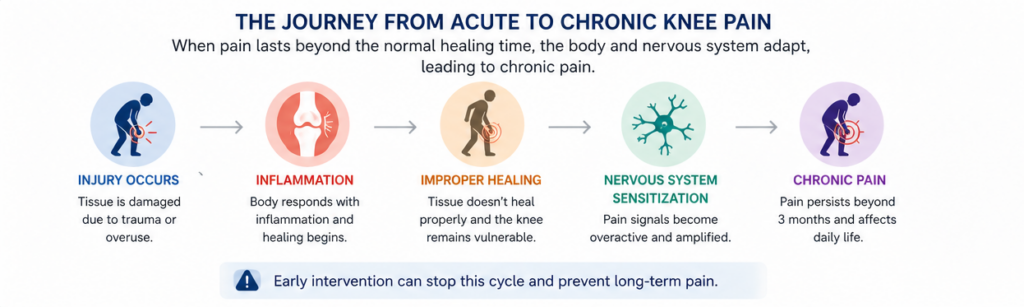
When you injure your knee, the body responds with inflammation and tissue repair.
This is a normal healing process.
But sometimes, healing does not complete properly.
Instead, the body develops:
- Persistent inflammation
- Altered movement patterns
- Increased nerve sensitivity
Over time, the pain system itself becomes overactive.
According to research from the National Institutes of Health, chronic pain can develop when the nervous system continues to send pain signals even after the initial injury has healed
https://www.ncbi.nlm.nih.gov/books/NBK538179/
This is why pain can persist even when imaging looks normal.
Why Knee Pain Becomes Chronic
Instead of fully recovering, the knee develops ongoing inflammation, weakness, and changes in how it moves.
This means the pain is no longer just about the injury itself, it becomes a condition involving the joints, muscles, and nerves working together.
Without proper treatment, this cycle can continue, making the pain harder to resolve.
Common Reasons Knee Pain Does Not Heal
1. Incomplete Healing
Returning to activity too early can prevent proper tissue repair.
The knee never fully stabilizes, leading to repeated irritation.
2. Weakness and Muscle Imbalance
After injury, surrounding muscles often weaken.
This changes how the knee moves and increases stress on the joint.
3. Joint Instability
Ligament injuries can leave the knee slightly unstable.
Even small instability can lead to long term pain and degeneration.
4. Nerve Sensitization
Pain pathways become more sensitive over time.
Even minor movement can trigger significant discomfort.
5. Poor Movement Patterns
To avoid pain, patients unconsciously change how they walk or move.
This creates additional strain and prolongs the problem.
When Acute Knee Pain Becomes Chronic
Pain is considered chronic when it lasts longer than three months.
At this stage, it is no longer just about the original injury.
It becomes a condition involving the nervous system, muscles, and joint mechanics.
Clinical evidence from the Centers for Disease Control and Prevention highlights that chronic pain often persists due to a combination of physical and neurological factors rather than a single structural issue
https://www.cdc.gov/chronicpain/index.html
This is why simply resting or taking pain medication is often not enough.
Why Ignoring Knee Pain Makes It Worse
Many patients delay treatment, hoping the pain will resolve on its own.
But untreated knee pain can lead to:
- Reduced mobility
- Progressive joint damage
- Increased risk of arthritis
- Long term functional limitations
Early intervention is key to preventing long term complications.
How Chronic Knee Pain Is Treated at Family First Pain Management
At Family First Pain Management, our pain management specialists in Athens, GA focus not just on reducing pain but identifying the root cause and restoring function.
It is to identify the root cause and restore function.
A comprehensive approach includes:
1. Accurate Diagnosis
Understanding whether the pain is coming from the joint, ligaments, muscles, or nerves
2. Movement Assessment
Evaluating how you walk, stand, and move
3. Targeted Treatment
Using therapies that address both pain and function
4. Long-Term Prevention
Correcting underlying issues to prevent recurrence
Treatment Options That Actually Work
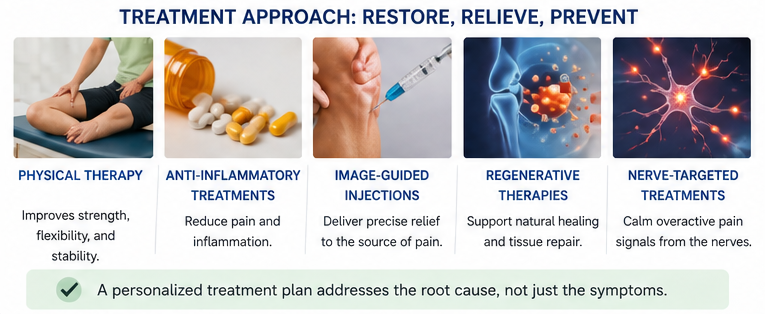
Depending on the cause, treatment may include:
- Physical therapy to rebuild strength and stability
- Anti inflammatory treatments to reduce irritation
- Image guided injections for precise pain relief
- Regenerative therapies to support tissue healing
- Nerve targeted treatments for persistent pain signals
The goal of effective chronic knee pain treatment is always the same, restore normal movement and reduce pain at its source.
Restore normal movement and reduce pain at its source.

Self-Assessment: Is Your Knee Pain Serious?
Ask yourself:
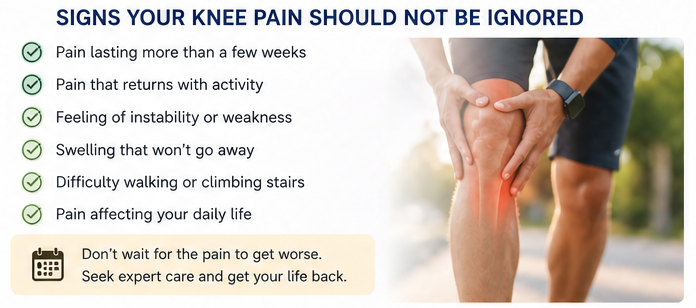
- Has my knee pain lasted more than a few weeks
- Does the pain return with activity
- Do I feel instability or weakness in the knee
- Has my movement or walking pattern changed
- Is the pain affecting my daily life
If you answered yes to two or more, your pain may be progressing toward a chronic condition and needs evaluation.
FAQs About Chronic Knee Pain
1. How long should knee pain last after an injury
Most minor injuries improve within a few weeks. Persistent pain beyond this should be evaluated2. Can knee pain exist without visible damage
Yes. Pain can persist due to nerve sensitivity even when imaging is normal3. Will rest alone fix chronic knee pain
No. Chronic pain usually requires active treatment and rehabilitation4. When should I see a pain specialist
If pain lasts more than a few weeks or limits your movement, it is time to seek care5. Are injections safe for knee pain
Yes, when performed appropriately, they can provide targeted relief and support recovery6. Can chronic knee pain be reversed
In many cases, yes. With proper treatment, function and comfort can be restored7. Does early treatment make a difference
Yes. Early intervention prevents long term complications and improves outcomesThe Bottom Line
Knee pain that does not go away is not something you should ignore.
It is a sign that your body needs more than rest.
Chronic knee pain develops due to a combination of incomplete healing, muscle imbalance, and nerve sensitivity.
The earlier you address it, the better your chances of full recovery.
Take the Next Step
If your knee pain is affecting your movement, your work, or your quality of life, it is time to act.
At Family First Pain Management, we focus on identifying the cause, not just masking the pain.
Because the goal is not just relief.
It is getting you back to living fully and moving confidently again.
Book your consultation now – https://firstpainmanagement.