

From Knee Injury to Chronic Pain: Why Your Pain Isn’t Going Away (And How to Fix It)
By Family First Pain Management
You injured your knee weeks or even months ago.
You expected it to heal.
But it didn’t.
Instead of improving, the pain stayed. Or worse, it spread. Now it affects how you walk, how you sit, how you sleep, and how you live your daily life.
If this sounds familiar, you are not alone.
At Family First Pain Management, we see this every day. What starts as a simple injury can quietly turn into chronic pain if not treated correctly and early.
The good news is this:
There is a reason your pain isn’t going away, and there is a way to fix it.
Why Some Knee Injuries Turn Into Long-Term Pain
Most people assume pain should disappear once the injury heals. But pain is more complex than that.
After an injury, your body goes through a healing process. However, in some cases, the pain system itself becomes overactive.
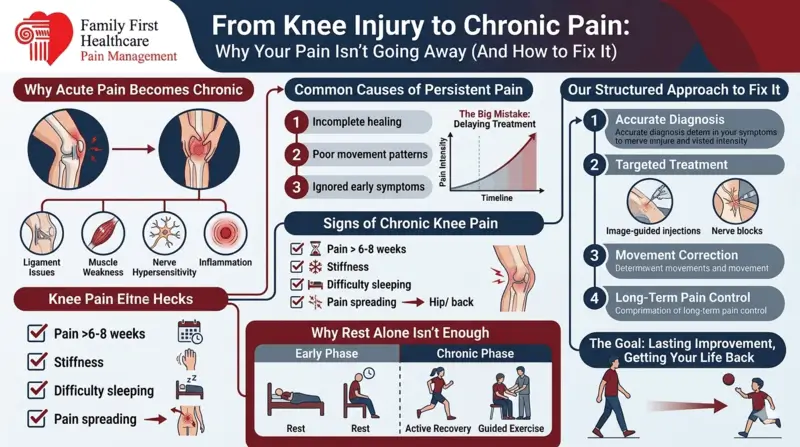
This can happen due to:
- Incomplete healing of ligaments or soft tissue
- Poor movement patterns after injury
- Nerve irritation or hypersensitivity
- Inflammation that never fully settles
- Delayed or incorrect treatment
Over time, your body starts to remember the pain. Even when the original injury improves, the pain signal continues.
This is how acute pain becomes chronic pain.
The Big Mistake: Ignoring Pain Early
One of the biggest reasons pain becomes long-term is delay.
Many patients:
- Ignore early symptoms
- Continue normal activity despite pain
- Self-medicate without diagnosis
- Wait months before seeing a specialist
By the time they seek help, the condition has progressed.
Pain that could have been managed early now requires a more structured treatment approach.
Signs Your Knee Pain Is Becoming Chronic
If you notice any of the following, your pain may no longer be just an injury:
- Pain lasting more than 6–8 weeks
- Pain that increases with normal daily movement
- Stiffness or reduced mobility
- Pain spreading to the hip or lower back
- Difficulty sleeping due to discomfort
- Dependence on pain medications
These are signals your body needs proper evaluation, not just rest.
Why Rest Alone Is Not Enough
Rest helps in the early phase of injury.
But prolonged rest without proper guidance can actually make things worse.
Lack of movement can lead to:
- Muscle weakness
- Joint stiffness
- Reduced blood flow
- Delayed recovery
Modern pain care focuses on guided recovery, not just inactivity.
How We Fix Chronic Knee Pain
At Family First Pain Management, we take a structured and personalized approach.
Step 1: Accurate Diagnosis
We identify the exact source of pain. Not just “knee pain,” but what is causing it.
Step 2: Targeted Treatment
Based on your condition, we may use:
- Image-guided injections
- Nerve blocks
- Anti-inflammatory treatments
- Regenerative approaches (when appropriate)
Step 3: Movement Correction
We help restore proper movement patterns so pain does not return.
Step 4: Long-Term Pain Control
The goal is not temporary relief.
The goal is lasting improvement.
Why Early Treatment Changes Everything
When pain is treated early:
- Recovery is faster
- Treatment is simpler
- Risk of chronic pain is lower
- Function returns sooner
Waiting often makes treatment longer and more complex.
The Real Goal: Getting Your Life Back
Pain is not just about your knee.
It affects:
- Your mobility
- Your confidence
- Your mood
- Your daily routine
Effective pain management is about restoring all of that.
At Family First Pain Management, we focus on helping you return to normal life, not just reducing pain scores.
Frequently Asked Questions
Why is my knee pain still there after months
Pain can persist due to incomplete healing, inflammation, or nerve sensitization. Chronic pain develops when the body continues sending pain signals even after the injury improves.
When should I see a pain specialist
If your pain lasts more than 6 weeks or affects daily activities, it is time for evaluation. Early care prevents long-term complications.
Can chronic knee pain be reversed
In many cases, yes. With proper diagnosis and targeted treatment, pain can be significantly reduced or eliminated.
Are injections safe for knee pain
When performed correctly under guidance, injections are safe and can provide effective relief by targeting the source of pain.
Do I need surgery for chronic knee pain
Not always. Many patients improve with non-surgical treatments offered through pain management.
Why does my pain spread to other areas
Compensation and altered movement patterns can shift stress to other joints, leading to pain in the hip or back.
Will pain keep coming back
If the root cause is not addressed, it can. That is why a complete treatment plan is essential.
Conclusion
If your knee pain is not improving, it is not something you should ignore.
Pain that lingers is your body asking for the right kind of attention.
The longer it is delayed, the more complex it becomes.
Take the First Step Toward Relief
At Family First Pain Management, we help patients move from ongoing pain to real recovery through personalized, evidence-based care.
If your pain is not going away, it is time to understand why.
Schedule your consultation today and take the first step toward getting your life back.